Saturday, July 30, 2011

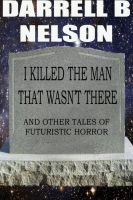
I Killed the Man that Wasn't There - Darrell B. Nelson


Author: Darrell B. Nelson
Date: 2011
Setting: the future, on Earth
Availability: Download I Killed the Man that Wasn't There on line, free

Story: A successful businessman, Ken, feels that he has been taken advantage of since high school by a pseudo-friend, Donald. When their research into space-time mechanics results in the building of a Trans-Dimensional Origami Reactor, Ken figures out how to exact revenge for all the wrongs done to him, which includes Donald stealing his wife, a powerful motive indeed. However, there are some repercussions that do not leave Ken unscathed.

Commentary: This is a very short story, and I don’t want to say so much that I give the plot away. All of Nelsons stories are science fiction, but of the four in this collection this is the most scientific. There is a bit of a physics lecture in the middle, which is delivered by Ken to Donald. Although it’s not totally out of place, it really feels as if it’s being given for the benefit of the reader. Nevertheless, it does manage to provide information which makes the story seem more plausible.

Although the setting is futuristic and the means of dealing with the despised person is creative, this is a classic story of revenge.

If you want some entertaining reading with sci-fi settings, Darrell B. Nelson writes creatively. The stories are not formula written with only a change of setting, so there is enough variety to keep you reading.


download free at Smashwords
Author info: Darrell B. Nelson is a former Securities Broker and Insurance Agent who has decided to use the total meltdown of his former industry, and the total destruction of any illusions of personal financial security the meltdown caused, as an opportunity to pursue a writing career. He has several books available at Smashwords. You can learn more at his blog, Project Savior

Rating:
Language skills 6
Depth of meaning 5


Saturday, July 2, 2011

Hitch-Hikers - Eudora Welty


Author: Eudora Welty
Date: 1941
Setting: Mississippi in the 1930s
Availability: in the short story collection A Curtain of Green

Story: Tom Harris, a traveling salesman, picks up two hitch-hikers on a road trip from Victory (Mississippi) to Memphis. One of the men talks a lot and is carrying a yellow guitar. The other man is very silent. Harris talks with the men, and soon realizes that they are hobos who have been traveling together for convenience for a couple of weeks.

He takes some pity on them and buys them dinner, and then asks the proprietor of a hotel where he often stays to let them sleep on his porch. While he is inside arranging this, the men apparently try to steal his car. The quiet man hits the man with the guitar over the head with a bottle, seriously injuring him. He is taken to the hospital and the assailant is locked in a room in the hotel, right across the hall from Harris, because the jail is full.

But this is one of Harris’ regular stops, and people in town know him. He’s popular at parties hosted by Ruth, a lady he knows. She introduces him to a girl named Carol, and they spend the evening together. She insists that she knew him from a long time ago, but he can’t remember her at all. There is much speculation at the party as to whether the guitar player will live or die.

Commentary: The Hitch-Hikers is a story with more questions than answers. On the surface it is a guileless portrayal of the Depression-era American South. Salesmen, hobos, forward girls, street children and “colored” children are presented without commentary, allowed to speak for themselves as to who they are and how they fit into society.

It is also the story of a man who is unable to connect with other human beings. Although Harris does show some hospitality toward the strangers, he never really forms even a simple kind of bond with them, and is oddly unmoved by their thievery, or the assault. He seems modestly curious about the prognosis for the injured man, but detached from the whole outcome, as well. He keeps forgetting what town he is in, even what girl he is with. He has no memory of Carol although she insists that she knows him.

When finally alone in his room he does not want to even take off his clothes, to feel any contact with the bed. The quiet becomes unbearable and he turns on the fan which clicks with every revolution and he welcomes the noise to shut out his thoughts.

In the final poignant scene he leaves town the next day, yet leaving more than the town behind him.


Author info: Eudora Welty 1909- 2001. Welty was born in Mississippi and developed an early love of reading. She earned several college degrees in an era when women seldom had any college education. During the Depression she worked for the WPA interviewing people and collecting photos of life in Mississippi. This experience became part of the basis of many of her short stories, which focused on Southern life. Several books of her short stories were published, and she won many prizes, including the Pulitzer.


Quote:
“He felt a... disturbing possessiveness, which meant nothing... He was free; helpless.”

Rating:
Language skills 9
Depth of meaning 8


Monday, May 30, 2011

Purgatory - Steven Thor Gunnin


Author: Steven Thor Gunnin
Date: 2010
Setting: The present, some U.S. city
Availability: In the anthology Elements of the Soul

Story: A man named Blackie tells the story, mostly in the first person. He has had a near-death experience when his car goes off a bridge, and he almost drowns. He is explaining all this to a trio of Mexican brothers at a strip joint. They want to know all about what it was like to come so close to death. Blackie is telling them, but making up a lot of it as he goes along. The three Latinos do figure out that he's teasing them at first, but as Blackie continues they have trouble separating the factual from the imaginary.

He explains that his job is to prepare bodies for autopsies at the morgue. He's been having a lot of strange experiences recently. In particular, he wants to talk about a girl named Jamie who committed suicide. However, it seems that Hector, Vincente, and Guillermo also knew Jamie.

Commentary: The dead and undead are Thor Gunnin's favorite themes, and there is plenty of suspense along those lines. That said, I had some trouble following this story. Sometimes Blackie just speaks in the first person, and sometimes he is referred to in the third person.

This story may not be for everyone. There is a lot of foul language, and a clear statement that admission to heaven is based on a merit system.

Author info: Steven Thor Gunnin is a graphic designer who writes in his spare time, and is a big fan of George Romero (Night of the Living Dead). Gunnin has two stories in this anthology.

Rating:
Language skills 4
Depth of meaning 2


Sunday, May 8, 2011

The Blue Hotel - Stephen Crane


Author: Stephen Crane
Date: 1899
Setting: Fort Romper, Nebraska, late 1800's
Availability: Read The Blue Hotel on line, free


Story: Three visitors disembark from the train at Romper, Nebraska, and are led to the Palace Hotel, painted a garish blue, by the proprietor, Patrick Scully. The three are an unpretentious Easterner, a very quiet man; a cowboy; and a Swede, who is the central figure in the story. Almost as soon as they arrive, a blizzard develops, so everyone is isolated at the hotel. The men, along with the proprietor’s son, Johnnie (a young adult), begin to play a card game. The Swede begins to make strange, loud pronouncements, beginning with "I suppose there have been a good many men killed in this room." He continues making inappropriate remarks throughout the game, even claiming that he knows he is going to be killed before the day is over. The others try to ignore him.

Patrick Scully, who is a good businessman, tries to placate and befriend the Swede, and to calm him down. He has some moderate success. Johnnie notes that his father is even willing to take some measure of abuse from the Swede just because the "customer is always right."

After dinner, the men begin another game of cards. The Swede is still too loud, speaks too often, and says bizarre things. At one point he accuses Johnnie of cheating. Johnnie takes offense, and the men all go out to the lee side of the hotel, still in a blizzard, to fight it out. Scully agrees that if Johnnie wants to fight for his honor that he will allow it.

When the Swede wins the fight he is still not satisfied and he leaves the hotel and makes his way into downtown, where he insinuates himself on the patrons of the town bar.

Commentary: The Blue Hotel is a story with many possible interpretations. There have been many analysts with more ability than I have who have tried to figure it out, who still can’t agree on what it means.

Almost certainly there is one set of meanings centered on the Swede’s misconception of what the "West" is like. He assumes that there is a lot of renegade actions and gunplay, and what he finds there does not match with his preconceptions.

There is a clear message of the self-fulfilling prophecy. If the Swede hadn’t been so dogmatic about what was going to happen, and so obnoxious to all, he probably wouldn’t have come to the end that he did.

Finally, another whole twist is put on the story by a sort of epilogue where the Easterner confirms that Johnnie was cheating and suggests to the cowboy that they all hold a certain level of responsibility for the fate of the Swede.

A part of me would like the blue hotel building to be symbolic of the world in general, but then the Swede leaves and moves the action to a different location. To carry this analogy along, Patrick Scully would need to be God, and the bar some sort of purgatory where the Swede receives his final judgment. Perhaps that does work!

There is a message that we are all pretty normal inside despite outward appearances. The hotel is painted a garish blue to make it stand out and attract customers, but then it is clearly quite a normal establishment once we see inside. Is this also a message about the true character of the Swede?

Clearly, that things are not what they appear to be is a strong theme. The gambler at the bar is more than a professional gambler, but also a family man and frequent participant in the local group of men who simply pass the time in discussing various topics of interest. Yet, he turns out to be the one who deals with the Swede in an unexpected way.

In any case, The Blue Hotel will give you plenty to think about.

Author info: Stephen Crane 1871-1900. Crane lived a short life, yet is recognized as one of the master American story tellers. Early on, he used themes from the naturalist school (we are victims of our environment), but later shifted to themes where people had more control over their own destiny. He was the son of a Methodist minister, and although he was gifted, never did well in school. He lived in extreme poverty most of his adult life, insisting that he pay his own way through writing. Even though Red Badge of Courage was acclaimed in his lifetime, he was never able to earn enough to raise his standard of living. He traveled through the American West as a syndicated journalist, and also traveled to Europe. He contracted tuberculosis, then malaria. He took such poor care of himself, that he died at age 28.


Unusual Words:
gripsack- a suitcase
sled-stake- a piece of wood which can be inserted in a sled frame to hold side boards- easily removeable, often used as a weapon, and necessarily straight.

Rating:
Language skills 9
Depth of meaning 9


Thursday, April 21, 2011

The Transition (The Crimson Pact) - Justin Swapp


Author: Justin Swapp
Date: 2011
Setting: the present, in Spain
Availability: in the Anthology The Crimson Pact, volume I

Story: Sloan, an American student studying in Spain, is waiting for his tutor and enjoying an espresso at an outdoor café. He is approached by an old man, a man who looks like a warrior, although he is dressed quite normally. After the man asks Sloan his name, and they carry on a short awkward conversation, the man places on the table a small die with strange markings. Sloan will never be the same again.

This is a flash fiction story, so a review will necessarily be short. However, it is part of The Crimson Pact, Volume I. This anthology has created a setting in the opening story, “The Failed Crusade,” by Paul Genesse and Patrick M. Tracy. To understand any of the 25 additional stories in the book some explanation of the opening story is necessary. At some time and place, both unidentified, humans have banded together to fight against demons who are attempting to conquer the world of men. The humans are losing the battle. However, they have all sworn to a pledge, called the Crimson Pact, that they will do whatever it takes to eventually hunt down the demons. At the end of the fateful day of loss, two people call upon the skills of a Spirit Coaxer and manage to cross over into the world of the demons.

The idea of the anthology is that the subsequent stories will build upon that introduction and tell the tales of those who crossed over and their descendants and followers throughout any age or world. Additional volumes are planned, and submissions are ongoing.

Commentary: The Failed Crusade is narrated by General Cruek Ostor, and has the feel of a cross between a medieval manuscript and a video game. The flowery language may make it difficult to immerse yourself into the world and the battle, but it has what I call “internal integrity.” This mean that you never are suddenly jogged into the wrong time or place by words or images that don’t belong. It took me a whole page to get into the story, but once I did, it worked well.

This opening story sets the stage for almost anything to happen with only a few basic ground rules that need to be followed. The remaining stories in the anthology are a complete mixture of styles- from stories that read like video game introductions to romance. “Transition” is set in the modern world, and if it were not for the fact that it’s in this anthology, would not signal any suspected direction for the plot too early.

The Crimson Pact is a classic good vs. evil fantasy. However, the contributions of many authors ensure that there are stories to please everyone, and you’ll never be able to predict where the next story will take you.

Author info: Justin Swapp grew up in a simple world where he played outside; running and hiding, talking openly to people, shooting pot guts, exploring caves, and generally looking for ways to exploit his imagination. The phrase "the pen is mightier than the sword" always fascinated him. Swapp got what it meant, but wanted to be able to wield that pen. And, he says, "that is harder than it looks."

Several other stories by Swapp can be read at his web site Justin Swapp: Fiction for your Reading Addiction


Rating:
Language skills 8
Depth of meaning 6


Wednesday, April 13, 2011

A Passion in the Desert - Honore De Balzac


Author: Honoré De Balzac
Date: 1830
Setting: Egypt, during the Napoleonic campaign of 1798
Availability: Read A Passion in the Desert on line, free


Story: A Passion in the Desert is a story within a story. The narrator is a man who has been to the zoo with his wife (described only as “she”). While they are watching a wild animal tamer she declares that the show is dreadful and she doesn’t believe that anyone can be so certain of the “affection” of a wild beast to trust it for performances.

The man takes issue with her and insists that he knows a story, told to him by an old soldier, which will prove that wild animals and humans can communicate. The next day, he tells her the story of “The Frenchman in Egypt.”

An old soldier, with one leg, had given this first person account of his experience in the desert during Napoleon’s campaign to conquer Egypt in 1798. He had been captured by the Arabs, but managed to escape into the desert where he despaired for his life. But he finds a small oasis, which has a spring, a few palm trees (for dates to eat), and a cave. He curls up to sleep in the cave, and in the morning finds that he is sharing the space with a “panther” (which is described in detail, identifying it to modern readers as a leopard).

The leopard has recently had a meal and she shows no interest in eating the soldier. In fact, the soldier and the cat develop an uneasy relationship, and their bond grows stronger and stronger. Man and beast play together; he caresses her gently, and she purrs ferociously in pleasure. But when an eagle appears overhead the soldier’s attention is drawn to it, and the relationship changes with dire consequences.

Commentary: A Passion in the Desert is clearly symbolic of the dangers, and stages of human love. It will take several readings to uncover all of the meanings. The most obvious layer is that the man is captivated by the beauty and power of the female, but that she is the one who is in control. She enjoys the attentions of the man, but never lets him forget that he is alive because she tolerates him.

The device of having an un-named man tell the story to his un-named wife strengthens the illusion of being able to separate oneself from the raw truths learned in the desert. The final line of the story, a quote from the old soldier, cuts through any self-delusion, leaving only naked truth.

In 1998 a short film of the same name was made, directed by Lavinia Currier. The movie is based on Balzac’s story, but adds a great deal to the plot, and changes the meaning significantly.

Author info: Honoré de Balzac (1799-1850) was one of the most obsessed writers of all time. His masterpiece, The Human Comedy, was written over the course of 20 years, on which he worked almost 16 hours a day, every day. He died of exhaustion at age fifty. The Human Comedy is a collection of stories covering the scope of the human condition. A Passion in the Desert was one of the first ones written.

Balzac is often remembered for his romantic and sensuous novels which sold quickly and were often banned. For example, his name is brought up in “The Music Man” as a scandalous writer, who should be avoided by proper people.

He is, however, considered one of the pioneers of realistic fiction, with the creation of multi-faceted characters who are neither wholly good or bad, but inherently human


Unusual Words:
Mangrabins- north-African Arabs, probably derived from Maghreb
ma petite maitresse- my little mistress
Mignonne- darling, etc- a term of endearment
simoom- a strong, hot, sand-laden wind of the Sahara and Arabian deserts

Rating:
Language skills 8
Depth of meaning 10


Wednesday, April 6, 2011

Flood of Tears - M. Lori Motley


Author: M. Lori Motley
Author web: M. Lori Motley
Date: 2009
Setting: anywhere, in the present day
Availability: In the anthology Elements of the Soul
 :

Story: Leesa and her son Ethan are just beginning to learn what life is going to be like for them since Leesa’s husband, Ethan’s father, was sent to prison for rape and murder. At school, Ethan’s former friend calls him names, while his mother confronts Leesa. Only Ethan’s teacher seems to understand, and show a willingness to treat Ethan as before. Ethan had been cast for the lead in the school play, “The Sword in the Stone,” and the boy is truly excited about being discovered to be King Arthur. Other children’s parents are not so sure they think the choice of students is appropriate for the role.

But on the way to opening night, a wild storm threatens to tear away the Carson Street bridge while Leesa and Ethan are crossing it in their unreliable truck.

Commentary: Flood of Tears explores the reactions of people when confronted with a genuine tragedy of life. Those near to a wrong-doer may be treated as if they share a part of the blame, while the accusers revel in their own self-righteousness. There is possibly a sub-theme of Old Testament justice.


Author info: M. Lori Motley's most prolific writing genres are sword & sorcery, contemporary and urban fantasy, horror, dark fantasy, comedic fantasy, and paranormal & fantasy romance.


Learn more about Lori at M. Lori Motley.


Rating:
Language skills 5
Depth of meaning 6